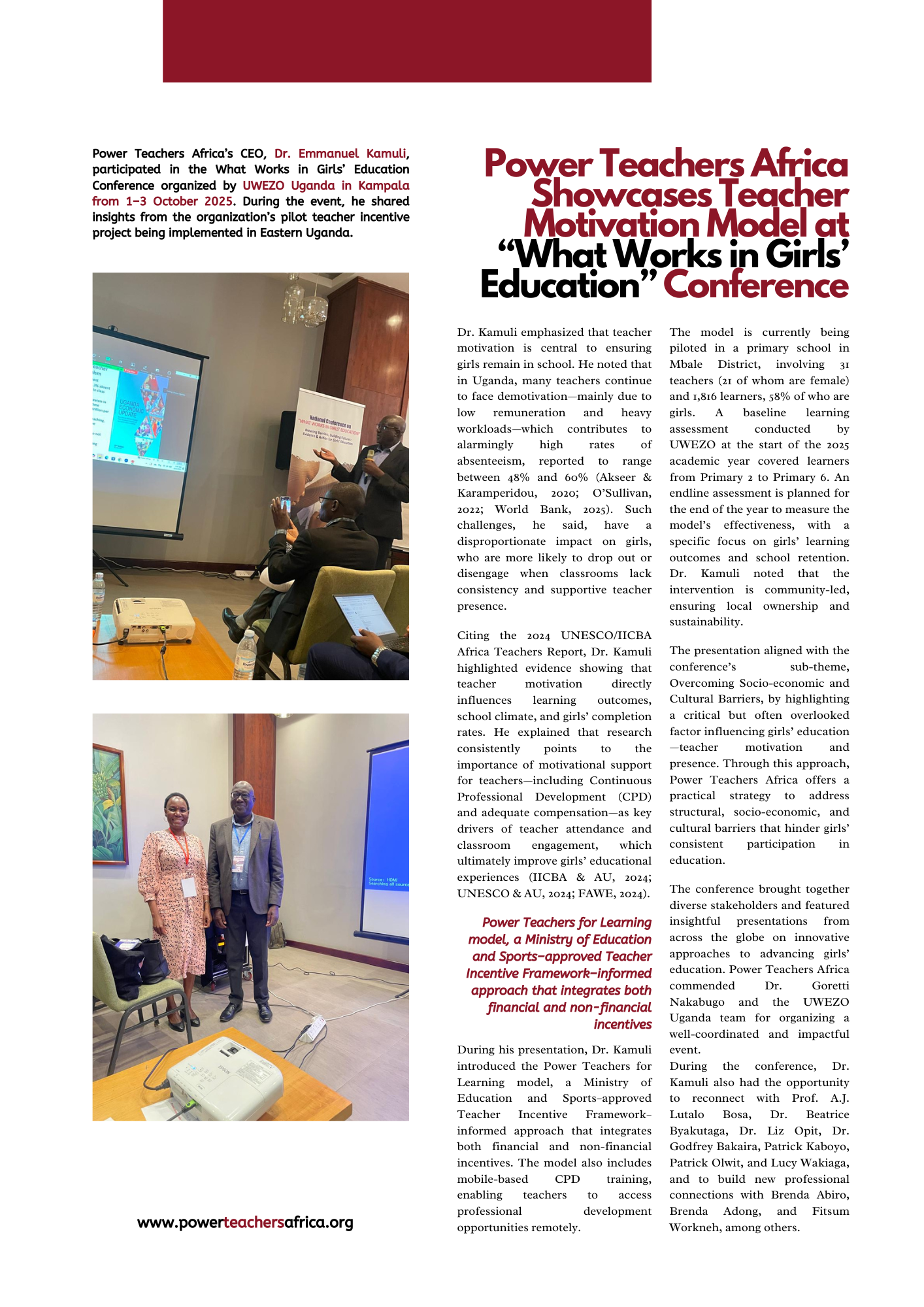
Power Teachers Africa’s CEO, Dr. Emmanuel Kamuli, participated in the What Works in Girls’ Education Conference organized by UWEZO Uganda in Kampala from 1–3 October 2025. During the event, he shared insights from the organization’s pilot teacher incentive project being implemented in Eastern Uganda.
Dr. Kamuli emphasized that teacher motivation is central to ensuring girls remain in school. He noted that in Uganda, many teachers continue to face demotivation—mainly due to low remuneration and heavy workloads—which contributes to alarmingly high rates of absenteeism, reported to range between 48% and 60% (Akseer & Karamperidou, 2020; O’Sullivan, 2022; World Bank, 2025). Such challenges, he said, have a disproportionate impact on girls, who are more likely to drop out or disengage when classrooms lack consistency and supportive teacher presence.
Citing the 2024 UNESCO/IICBA Africa Teachers Report, Dr. Kamuli highlighted evidence showing that teacher motivation directly influences learning outcomes, school climate, and girls’ completion rates. He explained that research consistently points to the importance of motivational support for teachers—including Continuous Professional Development (CPD) and adequate compensation—as key drivers of teacher attendance and classroom engagement, which ultimately improve girls’ educational experiences (IICBA & AU, 2024; UNESCO & AU, 2024; FAWE, 2024).
Power Teachers for Learning model, a Ministry of Education and Sports–approved Teacher Incentive Framework–informed approach that integrates both financial and non-financial incentives
During his presentation, Dr. Kamuli introduced the Power Teachers for Learning model, a Ministry of Education and Sports–approved Teacher Incentive Framework informed approach that integrates both financial and non-financial incentives. The model also includes mobile-based CPD training, enabling teachers to access professional development opportunities remotely.
The model is currently being piloted in a primary school in Mbale District, involving 31 teachers (21 of whom are female) and 1,816 learners, 58% of who are girls. A baseline learning assessment conducted by UWEZO at the start of the 2025 academic year covered learners from Primary 2 to Primary 6. An endline assessment is planned for the end of the year to measure the model’s effectiveness, with a specific focus on girls’ learning outcomes and school retention. Dr. Kamuli noted that the intervention is community-led, ensuring local ownership and sustainability
The presentation aligned with the conference’s sub-theme, Overcoming Socio-economic and Cultural Barriers, by highlighting a critical but often overlooked factor influencing girls’ education —teacher motivation and presence. Through this approach, Power Teachers Africa offers a practical strategy to address structural, socio-economic, and cultural barriers that hinder girls’ consistent participation in education.
The conference brought together diverse stakeholders and featured insightful presentations from across the globe on innovative approaches to advancing girls’ education. Power Teachers Africa commended Dr. Goretti Nakabugo and the UWEZO Uganda team for organizing a well-coordinated and impactful event. During the conference, Dr. Kamuli also had the opportunity to reconnect with Prof. A.J. Lutalo Bosa, Dr. Beatrice Byakutaga, Dr. Liz Opit, Dr. Godfrey Bakaira, Patrick Kaboyo, Patrick Olwit, and Lucy Wakiaga, and to build new professional connections with Brenda Abiro, Brenda Adong, and Fitsum Workneh, among others.