As we begin the 2026 academic school year, we warmly welcome our teachers in Uganda and across Africa. We wish you every success in the year ahead and extend our sincere thanks for the dedication, care, and professionalism you showed throughout 2025. Your work continues to change lives, classrooms, and communities.
At Power Teachers Africa, our teaching tips for Term 1, and indeed throughout 2026, will focus on one core skill that sits at the heart of effective teaching: questioning. Each week, we will release a short, practical tip, grounded in classroom reality and research. At the end of the term, these and other questioning tips will be brought together in a practical e-booklet that teachers can keep, use, and share.
Why questioning matters Research is remarkably consistent: effective questioning is one of the defining practices of effective teachers. (Westbrook et al, 2013). Studies repeatedly highlight the importance of using both open and closed questions, expanding student responses, encouraging students to ask their own questions, and using questions that provide genuine cognitive challenge (Coe et al, 2014). Importantly, research also shows that questioning is not a simple or mechanical skill.
It is complex, multifaceted, and purposeful. What matters most is not how many questions a teacher asks, but the type of questions and how they are used. Studies repeatedly highlight the importance of using both open and closed questions, expanding student responses, encouraging students to ask their own questions, and using questions that provide genuine cognitive challenge (Coe et al, 2014). Importantly, research also shows that questioning is not a simple or mechanical skill. It is complex, multifaceted, and purposeful. What matters most is not how many questions a teacher asks, but the type of questions and how they are used.
Questioning is also central to classroom talk. When teachers use questions well, they create classrooms where pupils explain, justify, compare, predict, and reflect. Research consistently finds that such classroom talk leads to improvements in learning outcomes, deeper understanding, and greater student engagement (Alexander, 2018).
Three core questioning areas and examples
Research shows that effective teachers develop their questioning expertise across three interconnected areas: ·Formulating questions – deciding what to ask and why ·Asking questions – deciding how, when, and who to ask.
Responding to answers – deciding what to do with students’ responses These three areas will structure our weekly teaching tips for the term. We will present a few examples below;
1. Formulating questions
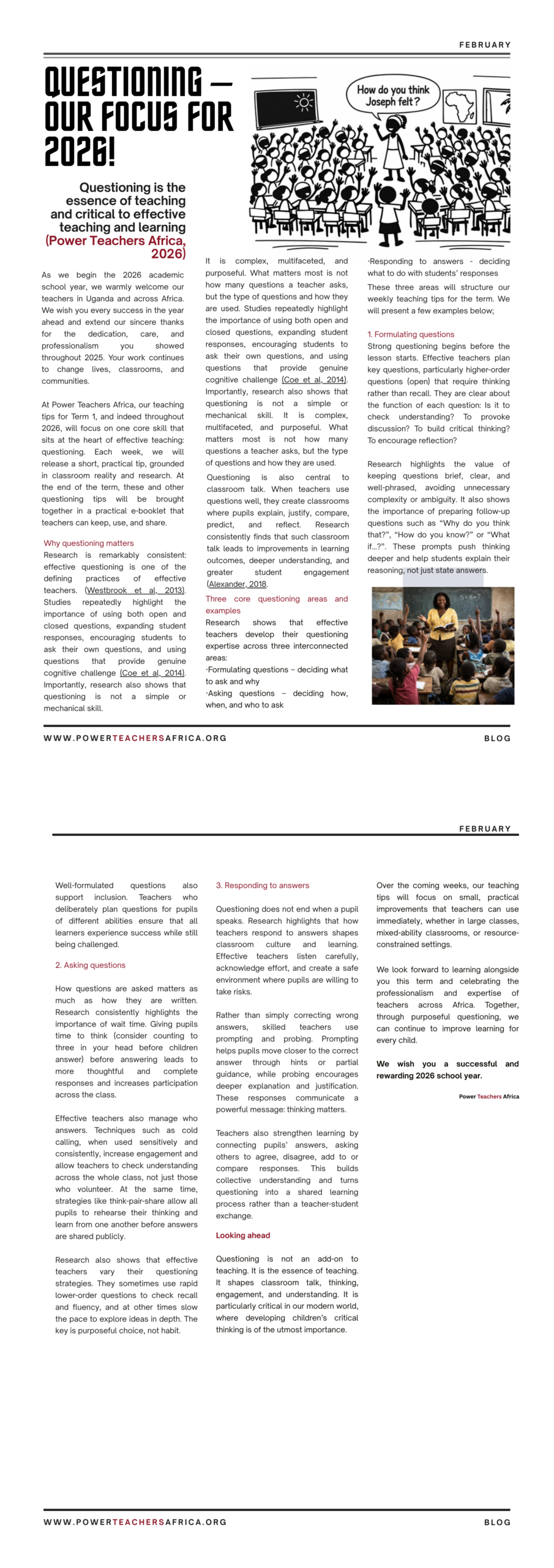
Strong questioning begins before the lesson starts. Effective teachers plan key questions, particularly higher-order questions (open) that require thinking rather than recall. They are clear about the function of each question: Is it to check understanding? To provoke discussion? To build critical thinking? To encourage reflection?
Research highlights the value of keeping questions brief, clear, and well-phrased, avoiding unnecessary complexity or ambiguity. It also shows the importance of preparing follow-up questions such as “Why do you think that?”, “How do you know?” or “What if…?”. These prompts push thinking deeper and help students explain their reasoning, not just state answers. Well-formulated questions also support inclusion. Teachers who deliberately plan questions for pupils of different abilities ensure that all learners experience success while still being challenged.
2. Asking questions
How questions are asked matters as much as how they are written. Research consistently highlights the importance of wait time. Giving pupils time to think (consider counting to three in your head before children answer) before answering leads to more thoughtful and complete responses and increases participation across the class.
Effective teachers also manage who answers. Techniques such as cold calling, when used sensitively and consistently, increase engagement and allow teachers to check understanding across the whole class, not just those who volunteer. At the same time, strategies like think-pair-share allow all pupils to rehearse their thinking and learn from one another before answers are shared publicly.
Research also shows that effective teachers vary their questioning strategies. They sometimes use rapid lower-order questions to check recall and fluency, and at other times slow the pace to explore ideas in depth. The key is purposeful choice, not habit.
3. Responding to answers
Questioning does not end when a pupil speaks. Research highlights that how teachers respond to answers shapes classroom culture and learning. Effective teachers listen carefully, acknowledge effort, and create a safe environment where pupils are willing to take risks.
Rather than simply correcting wrong answers, skilled teachers use prompting and probing. Prompting helps pupils move closer to the correct answer through hints or partial guidance, while probing encourages deeper explanation and justification. These responses communicate a powerful message: thinking matters.
Teachers also strengthen learning by connecting pupils’ answers, asking others to agree, disagree, add to or compare responses. This builds collective understanding and turns questioning into a shared learning process rather than a teacher-student exchange.
Looking ahead
Questioning is not an add-on to teaching. It is the essence of teaching. It shapes classroom talk, thinking, engagement, and understanding. It is particularly critical in our modern world, where developing children’s critical thinking is of the utmost importance.
Over the coming weeks, our teaching tips will focus on small, practical improvements that teachers can use immediately, whether in large classes, mixed-ability classrooms, or resource constrained settings.
We look forward to learning alongside you this term and celebrating the professionalism and expertise of teachers across Africa. Together, through purposeful questioning, we can continue to improve learning for every child.